
As home and office networks take on heavier workloads—4K streaming, giant project files, nonstop cloud syncing—the small parts of the cabling system start to matter a lot more than people expect.
One of the most common decisions people get stuck on is whether to use shielded or unshielded Ethernet keystone jacks. They look nearly identical, but they’re designed for completely different electrical environments. Pick the wrong one and you may end up with flaky connections, random packet drops, or you might spend more money than you ever needed to.
Let’s break this down in a simple, practical way so you know exactly which jack makes sense for your setup.
What Exactly Is a Network Keystone Jack?
A keystone jack is the little modular port that snaps into a wall plate, patch panel, or surface-mount box. When you terminate Ethernet (Cat5e, Cat6, Cat6A…), this is the connector that turns your cable into a clean, reliable Ethernet port.
These jacks play three big roles:
- Maintain signal quality by keeping the cable pairs properly aligned.
- Control internal noise, especially crosstalk between the pairs.
- Deliver the speed you expect, whether that’s 1G or 10G.
Where shielded and unshielded versions differ most is how they handle electromagnetic interference (EMI) and radio-frequency interference (RFI).
🛡️ Shielded Keystones: Heavy-Duty Protection for Noisy Environments
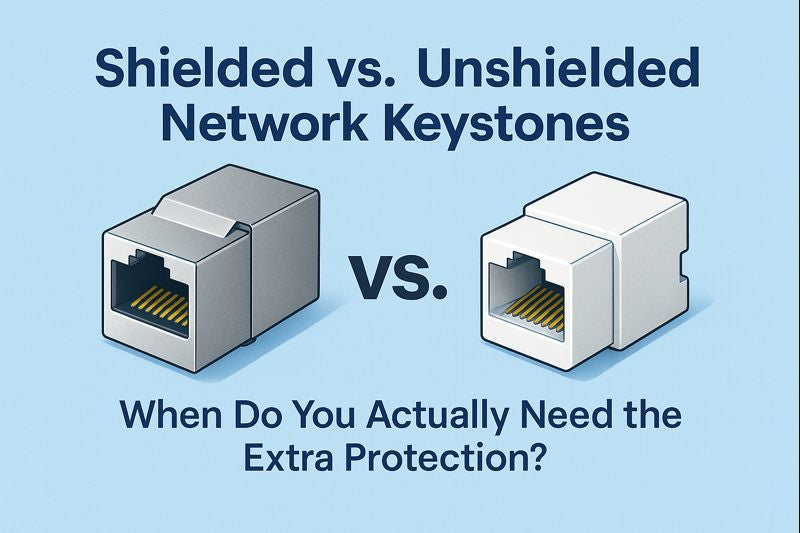
A shielded keystone is designed to pair with shielded twisted-pair (STP) cables. You’ll usually see a metal housing around the jack, which acts as a protective barrier to keep outside noise from messing with your data signals.
But here’s the part people miss: shielding only works if the entire system is shielded and properly grounded. That means:
- Shielded cable
- Shielded patch panels and patch cords
- Correct bonding/grounding all the way through
If any single part of the chain is unshielded, the whole benefit disappears.
When Shielded Keystones Make Sense
Shielded jacks offer:
- Excellent noise rejection, especially around motors, transformers, welders, or other heavy equipment.
- More reliable high-speed links, especially at 10G and up in challenging environments.
- Lower alien crosstalk when many cables run close together.
- Extra insurance for mission-critical work where downtime just isn’t acceptable.
💡 Unshielded Keystones: Simple, Affordable, and Perfect for Most Installs
Unshielded keystones pair with UTP cable, the type used in most houses and offices. Instead of metal shielding, they rely on the cable’s internal twisting and the jack’s engineering to keep interference under control.
For the majority of installations, unshielded components work flawlessly.
Why Many People Prefer Unshielded
- Lower cost across the board.
- Much easier installation—no grounding or shield continuity to worry about.
- Widely compatible with nearly every patch panel and wall plate.
- Excellent performance in environments without heavy EMI.
If your environment is electrically “clean,” UTP performs just as well as shielded in real-world use—even at 10 gigabit speeds.
🚨 Times When You Should Not Skip Shielding
There are situations where shielding isn’t a luxury—it’s a requirement. Choose shielded keystones if you’re installing cable near:
- Factories or manufacturing floors with motors, welders, or VFDs.
- Hospitals, especially near imaging equipment (MRI, CT, X-ray).
- High-voltage electrical runs or power distribution gear.
- Crowded data centers where hundreds of cables run side-by-side.
- Secure environments that require reduced electromagnetic emissions.
If the area is electrically noisy or reliability is absolutely critical, shielding is the safer bet.
✅ When Unshielded Is the Ideal Choice
Unshielded keystones shine in everyday environments:
- Homes and standard office buildings
- Cabling that stays well away from power lines
- Projects where speed, simplicity, and budget are priorities
As long as the installer maintains cable twist and avoids obvious EMI sources, UTP works extremely well—even for 10G.
📊 Shielded vs. Unshielded: Quick Comparison
| Feature / Requirement | Shielded Keystone | Unshielded Keystone |
|---|---|---|
| EMI/RFI Protection | Excellent—built for harsh electrical areas. | Moderate—depends on routing and cable quality. |
| Grounding Needed | Yes. | No. |
| Cost | Higher. | Lower. |
| Installation | More steps and checks required. | Straightforward. |
| Best For | Industrial, medical, or high-density installs. | Homes, offices, classrooms. |
| 10G Reliability | Extra safety margin in noisy environments. | Excellent in clean, well-planned spaces. |
❓ Still Not Sure? Ask Yourself:
Use this quick mental checklist:
-
Is the environment electrically noisy?
If yes, go shielded. -
Will the cable run close to major power lines or machinery?
Shielding helps avoid headaches later. -
Can you implement grounding properly?
If grounding is uncertain, unshielded may actually perform better. -
Is cost a major factor and the environment is quiet?
Unshielded is usually the smarter buy.
🙋 Common Questions
Can shielded and unshielded parts mix?
Within the same building, yes. Within the same cable run, no. Each channel should be all-shielded or all-unshielded from end to end if you want predictable performance.
Will shielded jacks make my network faster?
No. Shielding doesn’t increase speed. It helps the cable maintain its rated speed in difficult environments by protecting the signal from interference.
Do I need shielding for 10G Ethernet?
Not automatically. High-quality unshielded Cat6A handles 10G just fine in low-interference areas. Shielding mainly adds extra stability when conditions aren’t ideal.
Wrapping Up
Shielded and unshielded keystones each have their place.
Use Shielded when you’re dealing with noise, industrial equipment, medical gear, or dense cabling bundles where reliability is critical. Use Unshielded for typical homes, offices, and classrooms where simplicity and cost efficiency matter most.
With a clear picture of your environment and performance goals, choosing the right keystone becomes straightforward—and your network will thank you for it.