
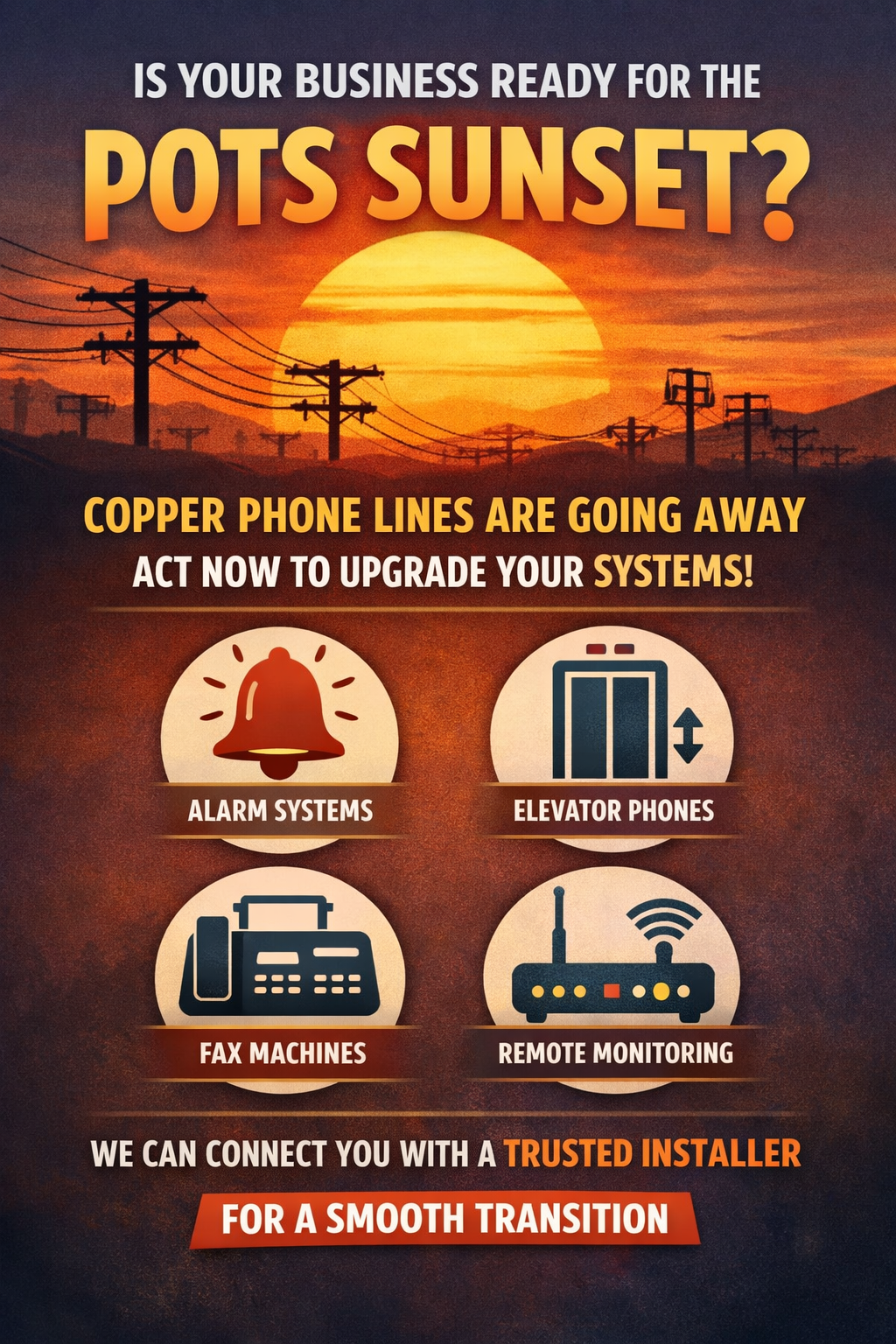
The POTS Sunset: What Businesses Need to Know Before It’s Too Late
For decades, POTS (Plain Old Telephone Service) has been the backbone of communication for businesses across the United States. These traditional copper phone lines have powered everything from desk phones and fax machines to alarm systems and elevators.
But that era is coming to an end.
Telecom providers are rapidly phasing out copper-based infrastructure, and the industry shift—commonly referred to as the “POTS Sunset”—will affect millions of businesses over the next few years.
If your organization still relies on analog phone lines, now is the time to start planning.
What Is the POTS Sunset?
The POTS Sunset refers to the gradual shutdown of traditional copper telephone networks that deliver analog phone service.
Telecom providers are retiring these networks because:
- Copper infrastructure is expensive to maintain
- Modern communications rely on fiber and IP-based technologies
- Equipment required to maintain copper networks is becoming obsolete
- Demand for analog services is rapidly declining
Major carriers like AT&T, Verizon, and others have already begun decommissioning copper networks in many areas, shifting customers to digital alternatives.
When Will the POTS Sunset Happen?
The sunset is already underway.
While exact timelines vary by provider and region, several key milestones are happening now:
- Many carriers have stopped installing new POTS lines
- Prices for existing analog lines are increasing dramatically
- Some areas are already experiencing forced migrations or service discontinuation
Industry analysts estimate that most copper networks will be largely retired by 2027–2030, though some areas will see shutdowns much sooner.
For businesses still using POTS lines, waiting too long can mean higher costs, limited options, and rushed migrations.
Why This Matters to Businesses
Many organizations don’t realize how many systems still rely on analog phone lines.
Common business systems using POTS include:
- Fire alarm panels
- Security alarm systems
- Elevator emergency phones
- Fax machines
- Modems
- Point-of-sale systems
- Building access systems
- Legacy PBX phone systems
- Remote monitoring devices
When POTS service disappears, these systems will stop functioning unless they are upgraded or converted to modern connectivity.
For businesses in regulated industries (healthcare, finance, government, etc.), this can also create compliance risks.
What Businesses Should Do Now
The biggest mistake organizations make is assuming they have plenty of time.
A proactive plan can prevent service disruptions and unnecessary expenses.
Here are the key steps every business should take:
1. Audit Your Existing Phone Lines
Start by identifying every analog line in your organization.
Many companies discover they have far more lines than expected, especially lines connected to legacy systems.
Create a list that includes:
- Phone number
- Location
- Device or system using the line
- Service provider
- Monthly cost
2. Identify Critical Systems
Next, determine which systems are mission-critical.
These often include:
- Fire alarm monitoring
- Security alarms
- Elevator emergency phones
- Emergency communication systems
These systems typically require reliable, always-on connectivity, so the replacement solution must meet safety standards.
3. Evaluate Replacement Options
Several modern technologies can replace POTS lines depending on the application.
Common alternatives include:
VoIP (Voice over IP)
Internet-based phone service that replaces traditional business phone lines.
Cellular-based POTS replacements
Devices that emulate analog phone lines but use cellular networks instead of copper.
Fiber-based voice services
Delivered through modern fiber infrastructure.
Each option has advantages depending on the device, reliability requirements, and building infrastructure.
4. Work with a Qualified Provider
Transitioning away from POTS often involves multiple systems, vendors, and compliance considerations.
A knowledgeable technology provider can help:
- Identify which lines can be eliminated
- Recommend the best replacement technology
- Ensure systems like alarms and elevators remain compliant
- Coordinate installation and migration
5. Plan for Cost Changes
Many businesses are shocked by the rapid price increases for legacy lines.
In some cases, analog lines that once cost $30 per month are now $80–$150 per line.
Migrating to modern solutions can significantly reduce these costs while improving reliability.
6. What the Transition Will Involve
A typical POTS replacement project may include:
- Site surveys
- Device compatibility checks
- Installation of POTS replacement gateways
- Network upgrades
- Coordination with alarm or elevator vendors
- Testing and compliance verification
- Decommissioning legacy lines
Planning early helps ensure these changes happen on your schedule—not the carrier’s.
The Bottom Line
The retirement of copper phone networks is no longer a future event—it’s happening now.
Businesses that take a proactive approach can:
- Reduce monthly telecom costs
- Improve reliability
- Modernize communication systems
- Avoid last-minute disruptions
Those that wait may face service interruptions, limited migration options, and higher emergency upgrade costs.
The smartest move is to start evaluating your POTS lines today and build a transition plan before the sunset reaches your location.
If your building still relies on copper phone lines for alarms, elevators, fax machines, or other systems, now is the time to start planning the transition.
The good news is you don’t have to figure it out alone.
We work with trusted professional installers who specialize in POTS line replacement and modernization. They can assess your current setup, recommend the right solution, and handle the installation to make the transition smooth and compliant.
If you’d like an introduction to a qualified installer who can help evaluate your systems, send me a message and I’ll connect you.
